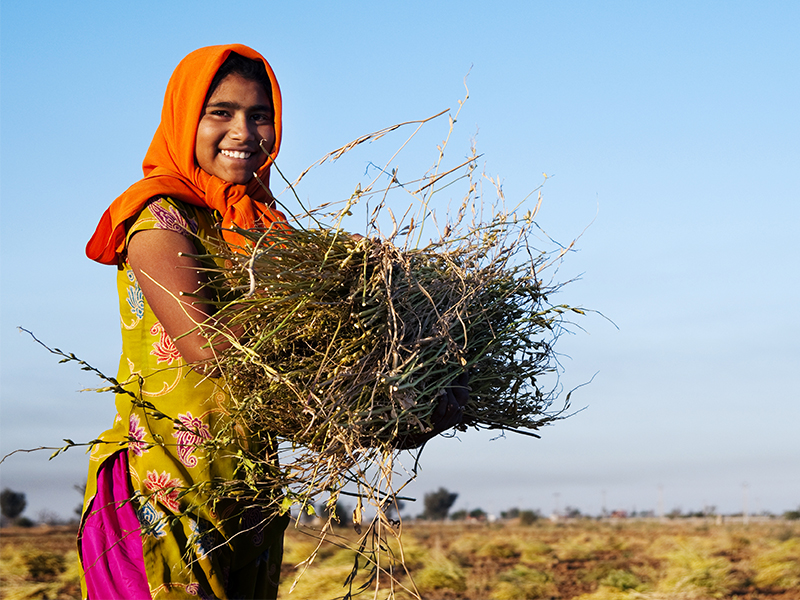
Rural development in India is a multidimensional process aimed at improving livelihoods, enhancing basic services, strengthening local institutions, and ensuring sustainability across agriculture and the non-farm rural economy. It integrates social inclusion, infrastructure creation, market access, and environmental stewardship to close the rural–urban gap and drive inclusive growth.
Components of rural development
- Economic development through diversified livelihoods across agriculture, allied sectors, and rural non-farm enterprises, supported by infrastructure such as roads, irrigation, power, storage, and digital connectivity.
- Social development via education, healthcare, sanitation, housing, social protection, and gender inclusion, with strong community participation and empowerment of local bodies.
- Institutional development covering Panchayati Raj Institutions, cooperatives, producer organizations, self-help groups, and rural financial intermediation for credit, insurance, and risk-sharing.
Approaches since Independence
- Community development and land reforms (1950s–60s) focused on tenancy regulation, redistribution, and local participation.
- Green Revolution and area development (1960s–80s) pursued input-intensive productivity growth and command-area development.
- Targeted poverty alleviation (1980s–2000s) emphasized wage employment, self-employment, and social safety nets for vulnerable groups.
- Rights-based and convergence models (2005 onward) combined guaranteed employment, housing, livelihoods, financial inclusion, and cluster-based planning under decentralized governance.
Sustainable rural development
- Resource stewardship through watershed management, soil health, water-use efficiency, and biodiversity conservation to anchor resilient agriculture and livelihoods.
- Climate-smart practices including diversified cropping, agroforestry, micro‑irrigation, renewable energy, and circular rural economies that reduce input intensity and post-harvest losses.
- Inclusive green growth via skill development, women’s collectives, and producer organizations integrating sustainability with market access and value addition.
Necessity for rural development
- Demographic and livelihood realities require raising farm and non-farm productivity to reduce poverty, underemployment, and distress migration.
- Food, nutrition, and energy security are closely tied to rural systems, demanding stable prices, reliable power, storage, and logistics.
- Balanced regional development and social cohesion depend on bridging service deficits and enabling equitable access to assets, finance, and opportunities.
Measures for development
- Strengthen physical infrastructure: all-weather roads, last‑mile power reliability, piped water, sanitation, irrigation, cold chains, warehousing, and broadband.
- Deepen human capital: universal foundational learning, vocational skills aligned to local value chains, primary healthcare, and public health resilience.
- Finance and markets: expand formal credit, crop and livestock insurance, digital payments, producer aggregation, grading, assaying, and transparent price discovery.
- Productivity and resilience: soil testing, improved seed and breed stock, extension and FPO-led services, precision input use, post-harvest management, and value-add processing.
- Governance and data: decentralized planning, social audit, geotagging of assets, outcome monitoring, and platform-based service delivery.
Rural development and rural management
- Rural development defines the goals and policy architecture; rural management operationalizes delivery through project design, resource mobilization, stakeholder coordination, and performance management.
- Effective rural management blends community engagement, supply chain design, public–private partnerships, and risk management to scale solutions sustainably.
Key issues in rural management
- Fragmented landholdings, market asymmetries, and low bargaining power hinder scale and value capture for producers.
- Service deficits (health, education, extension), capacity gaps in local institutions, and uneven digital access limit program execution quality.
- Climate risk, water stress, and post-harvest inefficiencies increase income volatility; weak logistics and standards constrain access to premium markets.
Marketing management in rural contexts
- Demand mapping and segmentation must reflect heterogeneous purchasing power, seasonality, and cultural preferences across geographies.
- Channel strategy blends haats, mandis, primary procurement centers, producer organizations, and digital marketplaces with last‑mile logistics and after-sales service.
- Branding and trust-building rely on demonstrations, influencer farmers, service guarantees, and localized communication in vernacular media.
Importance of agricultural prices
- Prices transmit incentives for resource allocation, cropping choices, technology adoption, and investment in inputs and mechanization.
- Stable and remunerative prices support farm incomes, reduce risk, and encourage diversification; volatility without safety nets can trigger distress sales and indebtedness.
- Price policy instruments—minimum support price operations, procurement, market reforms, storage and processing incentives, and risk markets—shape both welfare and efficiency outcomes.
CAIIB Rural Banking related article (elective)