A time deposit is a type of bank account that earns interest on the condition that the funds remain deposited for a predetermined period. The term “periodicity” in the context of time deposits refers to the specific duration for which the funds are committed. This term can range from as short as 7 days to as long as 10 years or more, depending on the financial institution.
Classification of Time Deposits
Time deposits are broadly categorized based on their duration:
- Short-Term Deposits: Typically ranging from 7 days to 12 months. These deposits provide relatively quick access to funds and are suitable for short-term financial goals.
- Long-Term Deposits: These extend from 1 to 10 years (or longer in select cases) and generally offer higher interest rates due to the longer commitment period.
Some banks and financial institutions may offer time deposits exceeding 10 years, often at preferential interest rates.
Operational Guidelines for Term Deposits
Term deposits—such as Fixed Deposits (FDs) and Recurring Deposits (RDs)—are governed by specific operational instructions, which may vary slightly across banks. These typically include:
Deposit Amount
Each bank prescribes its own minimum and maximum limits for time deposit amounts.
Maturity Instructions
At the time of opening the deposit, the customer may specify instructions for the treatment of maturity proceeds. Options include credit to a linked account, issuance of a demand draft, or automatic renewal for a similar term at prevailing interest rates.
Interest Calculation and Payment
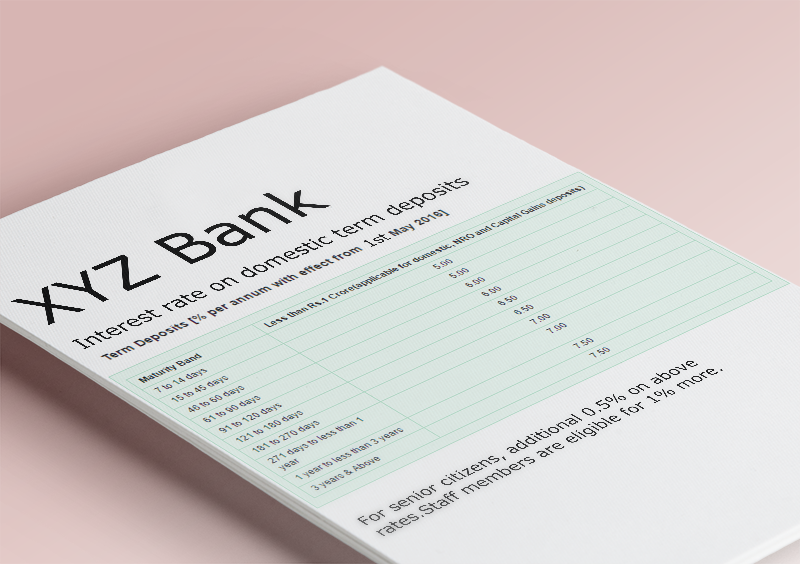
Interest on term deposits is usually calculated on a quarterly rest basis or longer. The payment of interest on non-cumulative deposits (where interest is paid out periodically) can occur monthly, quarterly, or half-yearly. Monthly payouts are typically offered at a discounted interest rate compared to other options.
Interest rates are influenced by various factors, including:
- The duration (tenure) of the deposit
- The bank’s internal policy
- Whether the depositor is a senior citizen (who are generally offered higher rates)
Premature Withdrawal
Withdrawals before the maturity date are subject to penalties, which may include:
- Penalty Charges: Usually a percentage deduction from the interest earned.
- Revised Interest Rate: The applicable rate is typically the lower of the original contracted rate or the rate applicable for the actual tenure the deposit remained with the bank.
Tax Deducted at Source (TDS)
Banks are mandated to deduct TDS on interest earned from term deposits if the interest income exceeds the threshold prescribed under the Income Tax Act.
Nomination Facility
Time deposit accounts allow nomination, enabling the designated nominee to receive the proceeds in the event of the depositor’s demise.
Joint Account Operation
Term deposits may be held jointly, with common modes of operation including:
- Joint (All Sign): All account holders must authorize transactions.
- Either or Survivor / Former or Survivor / Anyone or Survivor: Permits the surviving account holder(s) to operate the account after the other’s demise.
Renewal and Overdue Deposits
Automatic Renewal
If no maturity instructions are provided, the deposit may be renewed automatically for the same period at the prevailing interest rate.
Overdue Deposits
If a deposit is not renewed within a specified grace period (commonly 14 days), the bank may pay interest at a lower rate for the overdue duration.
Renewal Charges
While most banks do not charge a fee for renewal, penalties may apply in the event of premature closure.
Key Considerations
- Bank-Specific Policies: Policies on interest rates, penalties, and procedures vary by institution; hence, reading the terms and conditions is essential before investing.
- Maturity Communication: Banks are required to inform depositors at least 14 days prior to the maturity date of a term deposit.
- Regulatory Guidelines: The Reserve Bank of India (RBI) issues regulations governing the operation of term deposits, including nomination and premature withdrawal provisions.
Types of Term Deposits
- Fixed Deposits (FDs): A lump sum is deposited for a fixed period at a predetermined interest rate.
- Reinvestment Deposits (RDPs): Interest is reinvested at the contracted rate, allowing for compounding and withdrawal upon maturity along with the principal.
- Recurring Deposits (RDs): Allows periodic (e.g., monthly) deposits over a defined term, building a lump sum through disciplined saving.
- Tax-Saving FDs: Have a 5-year lock-in period and offer tax benefits under Section 80C of the Income Tax Act.
- Senior Citizen Deposits: Typically offer higher interest rates to individuals aged 60 years and above.
- Flexi FDs: Linked to a savings account and automatically transfer surplus funds into the deposit to earn higher returns.
- Sweep-In FDs: Automatically sweep excess funds from a savings account into a fixed deposit, ensuring better utilization of idle balances.
Related Posts: