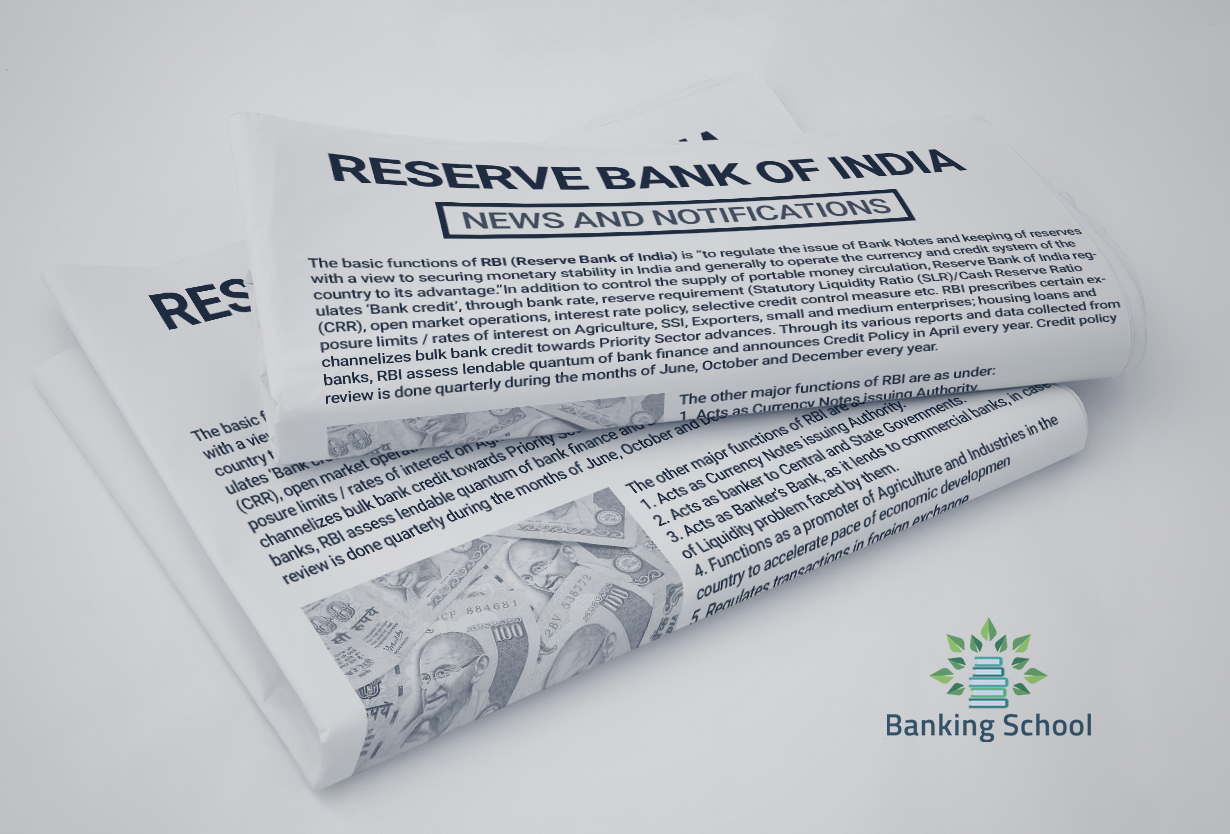
The Reserve Bank of India (RBI) serves as India’s central bank, established on April 1, 1935, under the RBI Act of 1934, to manage the nation’s currency, credit, and financial system. As the apex institution, the RBI regulates the banking sector, issues currency, and implements monetary policy to ensure monetary stability and economic growth. It also acts as the banker to the government and other banks, manages foreign exchange, and plays a significant role in the country’s development.
The Reserve Bank has also been empowered under the RBI Act 1934 to register, determine policy, issue directions, inspect, regulate, supervise and exercise surveillance over NBFCs that fulfil the principal business criteria or 50-50 criteria of principal business.
RBI as the Central Bank of India
- The RBI is the apex financial institution responsible for regulating currency issuance, managing monetary policy, and overseeing the country’s credit system to promote economic growth and price stability.
- RBI holds the exclusive right to issue currency notes in India (except the ₹1 note issued by the Ministry of Finance), controls money supply, and implements monetary policy tools like repo rate, Cash Reserve Ratio (CRR), and Statutory Liquidity Ratio (SLR) to regulate liquidity and inflation.
- Functions as the government’s banker and debt manager, managing accounts, government borrowing, payments, and public debt.
- Acts as lender of last resort by providing emergency credit to scheduled banks facing liquidity crises to prevent banking system instability.
- Oversees foreign exchange management, maintaining and regulating foreign currency reserves to stabilize the rupee’s exchange rate.
- Facilitates bank clearing and settlement functions as a clearinghouse, enabling smooth inter-bank transactions
RBI as Regulator of Banks and Non-Banking Financial Institutions (NBFCs)
- Under the Banking Regulation Act, 1949, RBI regulates and supervises all banking institutions in India to ensure their financial soundness and compliance.
- Through the Board for Financial Supervision (BFS), RBI supervises both banks and NBFCs, carrying out inspections, audits, and enforcing prudential norms to protect depositor interests and maintain systemic stability.
- Regulates NBFCs by setting capital adequacy norms, asset classification, provisioning standards, and ensuring transparency and fair practices in lending.
- Controls credit flow in the economy by regulating liquidity and credit creation by banks and NBFCs to avert inflationary or deflationary pressures.
Summary Table
| Role | Description | Examples/Key Instruments |
| Central Bank | Issue currency, manage monetary policy | Currency issuance, repo rate, CRR, SLR |
| Banker to Government | Manage govt. accounts, public debt | Govt. treasury accounts, government borrowing |
| Lender of Last Resort | Provide emergency liquidity to banks | Liquidity support to scheduled banks |
| Regulator of Banks | Supervise banks for health and compliance | Bank inspections, capital adequacy norms |
| Regulator of NBFCs | Monitor NBFCs, ensure fair practices & financial health | Capital norms, asset classification, disclosures |
| Foreign Exchange Manager | Manage FX reserves, stabilize currency | Forex interventions, maintaining reserves |
| Clearing House | Facilitate interbank settlements | Cheque clearing, interbank fund transfers |
The RBI’s dual role as the central monetary authority and the regulator of banks and NBFCs makes it pivotal in maintaining the financial system’s robustness, protecting the interests of depositors, and promoting economic growth sustainably.
Regulatory Framework for Banks
Legal Basis and Authority
- The RBI regulates banks primarily under the Banking Regulation Act, 1949, empowering it to supervise banking companies, ensure sound practices, and protect depositors’ interests.
- It has the authority to issue binding directions to banks for proper management, risk control, and capital adequacy.
- The RBI can intervene in banks showing financial stress, including applying Prompt Corrective Action (PCA) to mandate corrective measures for weak banks.
Supervisory Approach
- RBI uses a balanced approach combining on-site inspections (physical audits and examinations) and off-site surveillance (analysis of periodic returns and financial disclosures).
- Banks are assessed periodically on parameters like capital adequacy, asset quality, management quality, earnings, and liquidity (CAMELS model).
- The Board for Financial Supervision (BFS) under RBI oversees regulation and supervision, comprising RBI officials and external experts to strategize and make policy decisions.
Prudential Norms and Capital Requirements
- RBI mandates banks to maintain minimum capital adequacy ratios (as per Basel norms), ensuring adequate cushion against losses.
- Banks must adhere to asset classification norms, provisioning requirements, and exposure limits to control credit and market risks.
- Governance norms cover board composition, disclosure requirements, risk management frameworks, and internal controls.
Regulatory Framework for NBFCs
Classification under Scale-Based Regulation (SBR)
- RBI introduced the Scale-Based Regulatory (SBR) framework for NBFCs, categorizing them into layers based on size, risk profile, and systemic importance:
- Base Layer (NBFC-BL): Smaller, less complex NBFCs with minimal impact on the financial system.
- Middle Layer (NBFC-ML): Mid-sized NBFCs with moderate regulatory requirements.
- Upper Layer (NBFC-UL) & Top Layer (NBFC-TL): Systemically important NBFCs subject to stringent norms similar to banks.
Registration and Licensing
- NBFCs must obtain a Certificate of Registration (CoR) from the RBI, based on minimum net owned funds (currently ₹2 crore and above).
- RBI conducts due diligence on promoters, board members, and management to ensure fit and proper standards.
Prudential and Governance Norms
- NBFCs follow prudential norms on capital adequacy, asset classification, provisioning, exposure limits, and liquidity management.
- Corporate governance regulations emphasize board responsibilities, risk management committees, internal controls, and independent directors.
- Specific guidelines exist for customer protection, related-party transactions, and whistleblower policies to promote transparency.
Supervisory Mechanisms for NBFCs
On-site Supervision
- RBI conducts periodic on-site inspections based on risk assessment, asset size, and deposit-taking status. NBFCs with larger assets or deposit-taking status undergo more frequent and detailed audits.
- On-site inspections evaluate financial health, governance practices, risk management, statutory compliance, and capital adequacy.
Off-site Surveillance
- NBFCs are required to submit quarterly and annual financial returns. Higher-tier NBFCs submit more granular reports monitored by RBI’s surveillance systems.
- RBI uses data analytics and performance metrics to identify NBFCs with emerging risks or regulatory breaches.
Prompt Corrective Action (PCA) Framework
- RBI has extended the PCA framework to NBFCs for early intervention when key risk thresholds (capital, asset quality, profitability) breach prescribed limits.
- PCA aims to ensure corrective action before a NBFC becomes financially unsound, safeguarding stakeholders’ interests
Recent Enhancements and Emerging Focus
- RBI has merged regulatory frameworks for microfinance loans across banks and NBFCs to promote competition and protect borrowers.
- Digital lending by NBFCs is strictly regulated to prevent malpractices, requiring direct transfers through borrower accounts.
- Enhanced disclosure norms, anti-money laundering (AML) measures, and risk governance frameworks have been implemented to align NBFCs with the evolving financial landscape.
- The frameworks focus on balancing financial stability with innovation and inclusion.
In summary, RBI’s regulatory oversight and supervisory mechanisms ensure a robust, resilient, and transparent banking and NBFC sector that promotes financial stability, depositor safety, and market integrity, while also fostering innovation and inclusion through tailored regulations based on size and systemic impact.