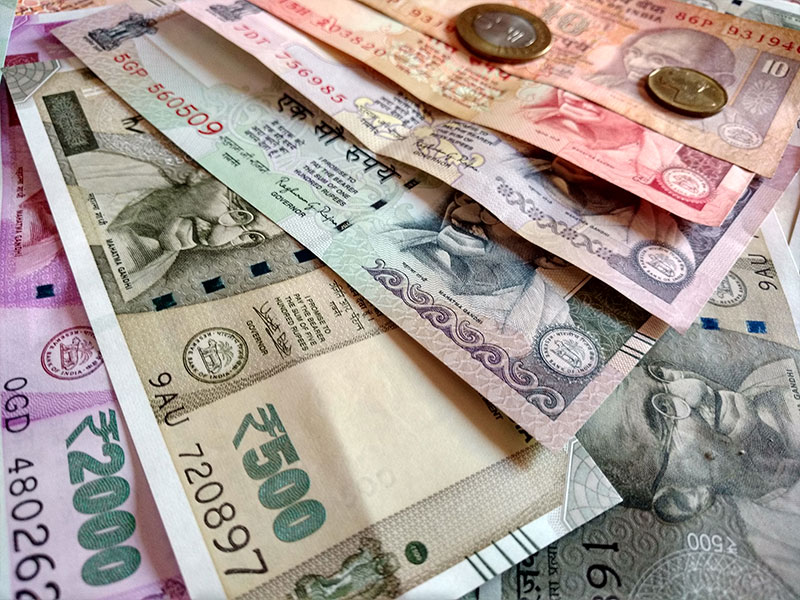
In India, over 90% of treasury operations in the foreign exchange (forex) market occur between banks. These inter-bank foreign currency transactions serve two primary purposes:
- Customer Transactions – Banks act as intermediaries to buy or sell foreign currency on behalf of their customers.
- Proprietary Trading – Banks engage in foreign currency trading on their own account to profit from fluctuations in exchange rates.
Understanding the Exchange Rate
The exchange rate is the price at which one currency is exchanged for another. It functions similarly to product pricing in a market. For example, just as a toothbrush may cost ₹50, the price of one US dollar may be ₹89 in the forex market.
How Exchange Rates Are Determined
Exchange rates are influenced by the demand for and supply of currencies. For instance:
- If the demand for US dollars decreases while supply remains high in India, the dollar’s value in rupee terms will fall. This is referred to as the rupee strengthening against the US dollar.
- Conversely, if demand for US dollars increases (e.g., due to higher imports or foreign investors withdrawing funds), the price of the dollar rises, and the rupee weakens against the dollar.
Exchange Rate Quotations
There are two standard methods to quote exchange rates:
- Direct Quotation – Home currency per unit of foreign currency.
- Indirect Quotation – Foreign currency per unit of home currency.
India adopted the direct quotation method from August 1, 1993. For example:
1 USD = ₹82.5850
Buying and Selling Rates
- Buying Rate – The rate at which an Authorized Dealer (AD) is willing to purchase foreign currency from the public.
- Selling Rate – The rate at which an AD sells foreign currency to the public.
The principle “buy low and sell high” applies to ADs, as they profit by purchasing foreign currency at a lower rate and selling at a higher rate. This results in customers receiving fewer rupees when selling foreign currency and paying more rupees when purchasing it.
When Are Different Rates Applied?
TT (Telegraphic Transfer) Buying Rate
Applied when the AD receives a clean inward remittance and funds are already credited to its NOSTRO account. Examples:
- Realization of collection instruments
- Cancellation of previously issued DD/MT/TT
- Cancellation of forward sale contracts
TT Selling Rate
Applied in the following cases:
- Issuance of DD/MT/TT in foreign currency
- Cancellation of unpaid bills previously purchased/discounted/negotiated
- Refunds or recoveries of credited inward remittances
- Cancellation of forward purchase contracts
Bill Buying Rate
Used when the AD purchases, discounts, or negotiates bills, or when cover is remitted between different centers.
Bill Selling Rate
Used when making payments for import bills.
Rates for Traveller’s Cheques/Currency Notes
Separate buying and selling rates apply. These rates are generally less favorable compared to other instruments.
Two-Way Quotation
In interbank forex trading, dealers typically provide a two-way quote—a bid rate (buying) and an ask rate (selling). Example:
USD 1 = ₹82.5850 (Bid) / ₹82.5950 (Ask)
This means the dealer is willing to buy USD at ₹82.5850 and sell it at ₹82.5950.
Merchant Rates
Authorized Dealers determine merchant rates by adding profit margins and exchange spreads to interbank rates, as per their internal policies.
Value Dates in Forex Transactions
| Transaction Type | Settlement Timeline |
| Cash | Same day |
| Tom | Next working day |
| Spot | Second working day |
| Forward | From the third working day onwards |
Forward Rates: Premium and Discount
In an indirect quote system:
- A premium means the foreign currency will be costlier in the future compared to the spot rate.
- A discount means the foreign currency will be cheaper in the future.
Premiums are added and discounts deducted from the spot rate to calculate forward rates.
Foreign Exchange Derivatives
Derivatives are financial instruments used to hedge risks such as exchange rate risk or interest rate risk. Their value is derived from an underlying asset. Common derivatives include:
- Forward Contracts
- Options
- Forward Rate Agreements (FRAs)
- Interest Rate Swaps
Derivatives are traded either on exchanges or over-the-counter (OTC). They carry market risk but help transfer risk from risk-averse investors to risk-seeking speculators.
Forward Contracts
A forward contract is an agreement between two parties to exchange currencies at a specified rate on a future date.
Futures Contracts
A futures contract is a standardized agreement to buy or sell a currency, commodity, or security at a predetermined future date and price. Unlike options, both parties must execute the deal on the agreed date.
Exchange Contracts
An exchange contract can be verbal or written, obligating parties to exchange currencies at a specified value date or, in the case of options, within a specified period.
Options Contracts
Two main types:
- Call Option – Gives the buyer the right to purchase an asset at a set price and time.
- Put Option – Gives the seller the right to sell an asset at a set price and time.
There is no obligation for the buyer or seller to exercise the option. If the market is unfavorable, they may allow the option to lapse, incurring only the cost of the option premium. Options are commonly used for hedging against price volatility and speculative profit opportunities. The maximum permissible option period is one calendar month, and delivery must be made on the preceding working day if the due date is a holiday.
Related Posts: