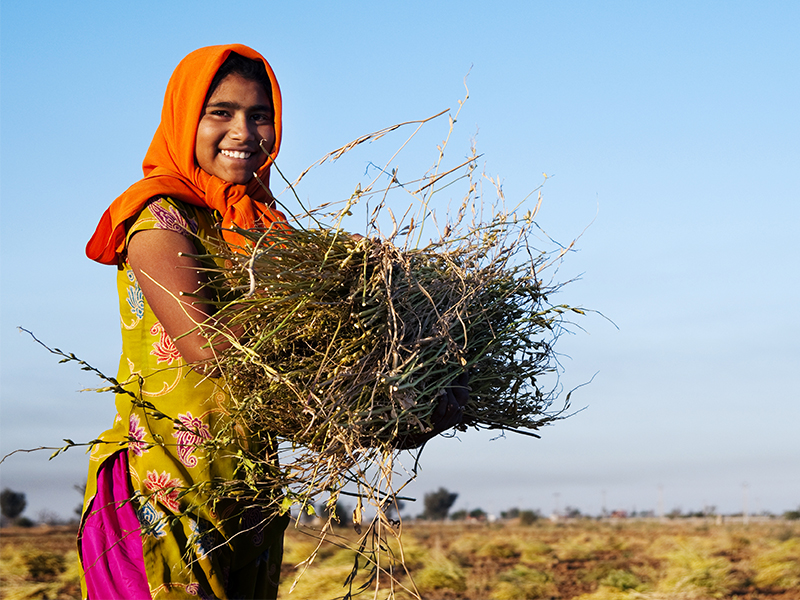
The scheme provides comprehensive support to rural households for the construction of permanent houses, alongside convergence with other government schemes for basic amenities such as sanitation, clean fuel, and employment. Key benefits include:
- Financial Assistance:
- ₹1,20,000 per unit in plain areas.
- ₹1,30,000 per unit in hilly regions, difficult areas, and Integrated Action Plan (IAP) districts, including the Himalayan states, North-Eastern states, and the Union Territory of Jammu & Kashmir.
- Interest Subsidy:
- Under PMAY-G (Pradhan Mantri Awas Yojana – Gramin), eligible rural beneficiaries can get a 3% interest subsidy on their housing loan for building a permanent house. This subsidy applies to loans of up to ₹70,000 and the maximum principal amount for which subsidy is available is ₹2,00,000. The subsidy helps make home ownership more affordable for rural households.
- Institutional Finance:
- Beneficiaries may avail of institutional loans up to ₹70,000 at a concessional interest rate, with an interest subsidy applicable on a maximum principal of ₹2,00,000.
- Housing Specifications:
- Minimum house size: 25 sq. meters, inclusive of a hygienic cooking area.
- Convergence with Other Schemes:
- Swachh Bharat Mission-Gramin (SBM-G): Financial support of ₹12,000 for toilet construction.
- MGNREGA: Employment as unskilled laborers (including Rural Mason Training) at ₹90.95 per day for up to 95 days.
- Pradhan Mantri Ujjwala Yojana: Provision of one LPG connection per household.
- Additional benefits through linkage with schemes for piped drinking water, electricity, clean cooking fuel, and sanitation.
- Fund Disbursement:
- Payments are transferred electronically to Aadhaar-linked bank or post office accounts to ensure transparency and prevent fund misuse.
Eligibility Criteria
Beneficiaries are selected using the “Housing Deprivation Parameters” from the Socio-Economic and Caste Census (SECC), further validated by the Gram Sabhas. Households must meet one or more of the following criteria:
- Households without shelter
- Destitute individuals or those dependent on alms
- Manual scavengers
- Primitive Tribal Groups
- Legally released bonded laborers
Prioritization Criteria
Scheduled Castes/Scheduled Tribes (SC/ST):
- 60% allocation to each State/UT. If all eligible SC/ST households are covered, the balance targets are allocated to other eligible categories from the permanent waitlist (SECC 2011).
Minorities:
- 15% allocation at the national level. Beneficiaries must belong to communities notified under Section 2(c) of the National Commission for Minorities Act, 1992.
Persons with Disabilities (PwDs):
- Households with disabled members and no able-bodied adult members receive higher deprivation scores, ensuring prioritization. States are encouraged to allocate at least 3% of the houses to PwDs.
Tie-Breaker Provisions
In case of a tie in deprivation scores, the following criteria are considered for ranking:
- Households with widows or next of kin of defense/paramilitary/police personnel killed in action.
- Households with members suffering from leprosy, cancer, or HIV/AIDS.
- Households with a single girl child.
- Beneficiaries under the Forest Rights Act, 2006.
Scoring and Ranking Mechanism
Eligible households are ranked based on a multi-tier priority system considering social category (SC/ST, Minorities, Others) and housing condition (houseless, number of rooms).
Further ranking within categories is determined by cumulative deprivation scores, derived from the following socio-economic indicators (each with equal weight):
- No adult member between ages 16–59.
- Female-headed households with no adult male member aged 16–59.
- No literate adult above 25 years.
- Presence of a disabled member with no able-bodied adult.
- Landless households primarily earning from manual casual labor.
Monitoring and Implementation
- AwaasSoft Portal: All beneficiary data, fund releases, photographs, and inspection reports are documented and monitored through this platform.
- Geo-Tagged Monitoring: Time-stamped photographs at each stage of construction are uploaded to ensure progress verification.
- Inspections:
- Block-level officers inspect 10% of houses.
- District-level officers inspect 2% of houses at each stage.
- National-level monitors and Ministry officials conduct periodic field visits.
- Project Management Unit (PMU): Responsible for implementation, monitoring, and quality supervision at the State level. Each house is assigned to a village-level functionary for follow-up.
- Social Audits: Conducted annually in every Gram Panchayat.
- Direct Benefit Transfers: Assistance is provided in construction-linked installments via Aadhaar-enabled payments through the PFMS platform.
- Grievance Redressal:
- Complaints can be lodged on the Centralized Public Grievance Redress and Monitoring System (CPGRAMS) at pgportal.gov.in.
- Additional mechanisms include State-level Integrated Grievance Redressal Systems (IGRS) and Chief Minister helplines.
Exclusion Criteria
Step 1: Structural Criteria
Households with:
- Pucca roofs and/or pucca walls.
- More than two rooms.
Step 2: Automatic Exclusion (based on SECC data)
Households meeting any of the following 13 criteria are excluded:
- Ownership of motorized vehicles (two/three/four-wheelers or fishing boats).
- Mechanized agricultural equipment.
- Kisan Credit Card with a credit limit ≥ ₹50,000.
- Any government employee in the household.
- Ownership of registered non-agricultural enterprises.
- Household member earning ≥ ₹10,000/month.
- Payment of income tax.
- Payment of professional tax.
- Ownership of a refrigerator.
- Ownership of a landline phone.
- Ownership of 2.5 acres or more irrigated land with irrigation equipment.
- Ownership of ≥5 acres irrigated land across two cropping seasons.
- Ownership of ≥7.5 acres of land with irrigation equipment.
This comprehensive framework ensures that PMAY-G benefits reach the most vulnerable sections of rural India, using a transparent, data-driven, and participatory approach to achieve the vision of “Housing for All.”
The following article will delve into every aspect of home loans—from HOW TO EXAMINE TITLE DEEDS WHILE BUYING HOUSE PROPERTY, eligibility, documentation, switch over charges, fixed and floating interest rates, teasing interest rates to comparisons across banks, loan transfer procedures, and smart tips for choosing the right loan product. In addition to the above benefits of RERA and CERSAI data are also explained.
UNDERSTANDING HOME LOANS IN INDIA: A COMPREHENSIVE GUIDE
Related Posts: