Introduction
When travelling abroad, it is essential for Indian residents to understand the foreign exchange limits and RBI guidelines on carrying cash and currency. Both India and the destination country impose restrictions on the amount of Indian and foreign currency that can be carried in cash. Knowing these currency carrying rules not only helps you comply with the Foreign Exchange Management Act (FEMA) but also ensures a smooth travel experience without regulatory issues at customs checkpoints.
1. General Guidelines for Travellers
Before you travel, it is important to check both Indian regulations and the entry requirements of your destination country. Each nation has its own rules about how much cash can be brought in, and exceeding those limits without declaration may lead to penalties or confiscation.
2. Permissible Foreign Exchange for Indian Travellers
Under the Liberalised Remittance Scheme (LRS), resident individuals can remit up to USD 250,000 (or equivalent) per financial year for permissible transactions, including travel abroad.
Travellers may purchase foreign currency notes or coins up to USD 3,000 per visit. The balance can be carried through store-value cards, traveller’s cheques, or banker’s drafts within the overall LRS limit.
- Exceptions:
- Iraq and Libya: Foreign currency notes and coins up to USD 5,000 per visit.
- Iran, Russia, and CIS countries: Entire entitlement (up to USD 250,000) may be drawn in the form of notes or coins.
- Haj/Umrah pilgrims: Full entitlement (USD 250,000) in cash or as per the limit prescribed by the Haj Committee of India.
3. Indian Currency Limit
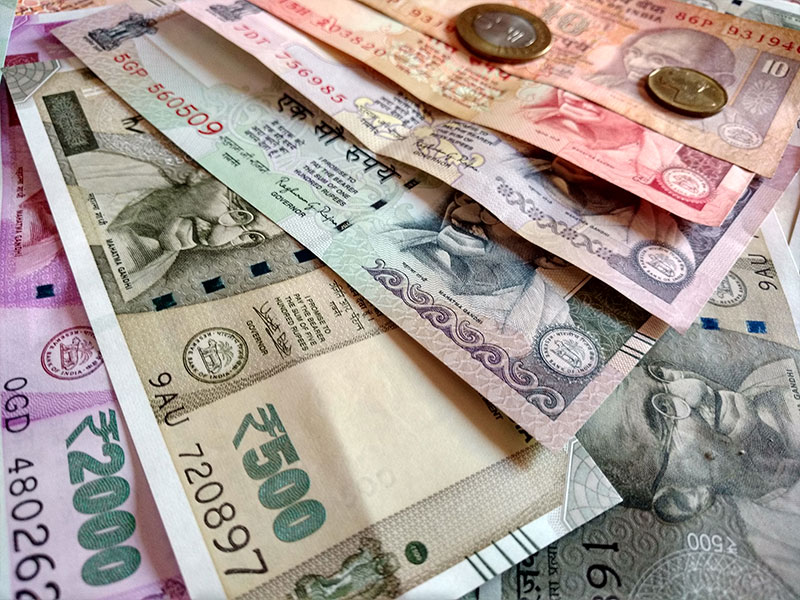
Resident travellers are allowed to carry Indian currency notes up to ₹25,000 when travelling abroad.
4. Country-Specific Currency Limits
| Destination Country | Cash Limit | Declaration Requirement / Notes |
| European Union (France, Spain, Germany, Italy, Greece, etc.) | Less than EUR 10,000 | Declare amounts above EUR 10,000 to customs on arrival. |
| United States of America (USA) | Up to USD 3,000 per person | Remaining funds can be carried via Forex cards, traveller’s cheques, or bank transfers. |
| Canada | CAN 10,000 or more | Must be declared to border security officers. |
| Thailand | THB 50,000 maximum | Minimum threshold: THB 10,000 per person / THB 20,000 per family. |
| United Kingdom (UK) | No upper limit | Declaration required for £10,000 or more when entering or leaving the UK. |
| Australia | Less than AUD 10,000 | Declaration required for higher amounts. |
| Singapore | S$20,000 or more | Mandatory declaration under the Corruption, Drug Trafficking and Other Serious Crimes (Confiscation of Benefits) Act, 1992. Non-compliance can lead to fines up to S$50,000 or imprisonment up to three years. |
| Mauritius | Less than MUR 500,000 | No declaration required below this limit. |
| Nepal and Bhutan | Up to INR 25,000 | ₹500 and ₹2,000 notes are not permitted. Carry denominations of ₹100 or lower. |
Read: Travel guidance for Indian Citizen visiting Nepal and Bhutan
5. Carrying Jewellery and Valuables
Travellers may carry jewellery and other personal valuables abroad as part of their bona fide baggage without any specific value limit. However, they must declare such items at the time of departure and obtain an export certificate from Indian Customs to avoid paying duty when returning to India.
6. Mode of Payment for Purchasing Foreign Exchange
Foreign exchange can be purchased from an Authorised Dealer (AD) or Full-Fledged Money Changer (FFMC):
– For amounts below ₹50,000, payment can be made in cash.
– For amounts ₹50,000 and above, payment must be made by crossed cheque, banker’s cheque, pay order, demand draft, debit/credit card, or prepaid card.
7. Use of International Debit and Credit Cards (IDCs/ICCs)
• International Debit Cards (IDCs): May be used abroad for permissible current account transactions within the overall LRS limit.
• International Credit Cards (ICCs): Can be used for payments abroad, subject to limits fixed by the issuing bank. Transactions can be settled from the cardholder’s foreign currency account or through permitted bank remittances.
• ICC/IDC usage is not permitted for prohibited transactions (e.g., lottery tickets, banned publications) listed under Schedule I of the FEM (CAT) Amendment Rules, 2015.
• Usage of ICCs and IDCs is not allowed in Nepal and Bhutan.
Conclusion
Understanding the foreign exchange limits and RBI travel guidelines on carrying Indian and foreign currency abroad is vital for all international travellers. Each country enforces its own customs rules, and failure to declare large sums may result in fines or legal action. Always obtain foreign exchange from authorised dealers, retain transaction receipts, and stay updated on the latest FEMA regulations before travelling. Being informed ensures compliance, safety, and a hassle-free journey.
Travel guidance related Posts:
Disclaimer: This article is written and updated from time to time based on RBI circulars or FEMA rules and amendments taken place. We make every effort to stay as accurate and updated as possible. However, for further validation, you may refer RBI circular on ‘Liberalised Remittance Scheme (LRS) for Resident Individuals’. The author of this article is not responsible for the mistakes, errors, ambiguity, inconsistency, discrepancy, doubts, or quality of information provided in this article. The liabilities or claims of any nature on account of the information provided in this post for whatsoever cause is not recognized.
Related Posts: