
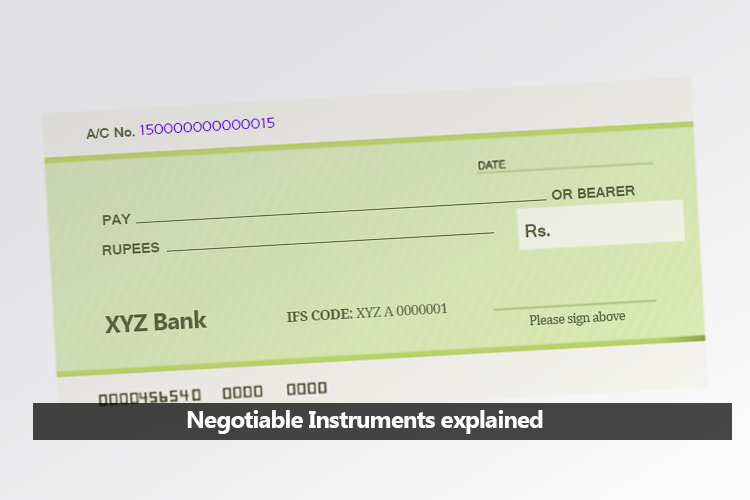
Features of a cheque leaf
A Cheque is a specially printed paper form issued by the banks to their customers to draw money or pay monies to third parties from their running account like SB/Current Account, Cash Credit Account etc. that contains following features. When you look at a cheque, you find the name of the bank and address of…
Read article
Sharing of capital deficiency by the partners
[This article distinguishes on General rule and Garner v Murray rule, in sharing of deficiency of capital on account of insolvency of the partner(s)] Capital deficiency means that one or more partner has a debit balance in his/their capital account at the point of final cash distribution. The capital deficiency may arise from liquidation losses,…
Read article
What is yield based and price based auction of Government securities
[This article explains the meaning of yield based and price based auction with the illustrations of yield based auction and auction Sale (Re-issue) of Government Securities] The Government securities are issued by way of auctions conducted by the RBI on the electronic platform called the NDS – Auction platform. The banks, Insurance Companies, Mutual Funds,…
Read article What is the difference between a bill of exchange and a Cheque?
The bills of exchange are a kind of negotiable instruments generally arising out of trade transactions. Demand bills, Usance bills, Clean bills, Documentary Bills, Accommodation bills, etc. are the examples of bills of exchange in usage for different types of trade transactions. A cheque is also a kind of bill of exchange. However, cheque has some…
Read article Definition of bill of exchange
Section 5 of the NI Acts 1881 defines a bill of exchange as under “A bill of exchange is an instrument in writing containing an unconditional order, signed by the maker, directing a certain person to pay a certain sum of money to, or to the order of, a certain person or the bearer…
Definition of Usance Bills
Section 22 of Negotiable instrument act 1881 provides that “every promissory note, bill of exchange which is not expressed to be payable on demand, at sight or on presentment is at maturity on the third day after the date on which is expressed to be payable”. Thus, in the case of Usance bills, three days…
Read article