Government’s Regulatory Role in Banking

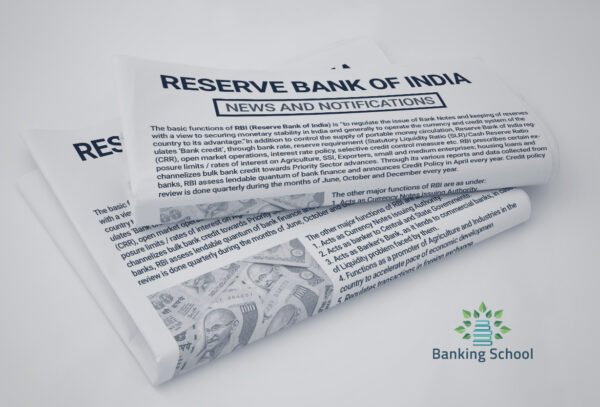
The government plays a crucial role as a regulator of banks primarily through the central bank and legislative framework. In India, for example, the Reserve Bank of India (RBI) acts as the central bank and chief regulator of the banking sector, empowered by statutory acts such as the Banking Regulation Act of 1949 and the…

RBI as the Central Bank of India and Regulator of Banks and Non-Banking Financial Institutions (NBFCs)

The Reserve Bank of India (RBI) serves as India’s central bank, established on April 1, 1935, under the RBI Act of 1934, to manage the nation’s currency, credit, and financial system. As the apex institution, the RBI regulates the banking sector, issues currency, and implements monetary policy to ensure monetary stability and economic growth. It…

Legal Framework of Banking Regulation in India: Understanding the Business of Banking

Introduction The Indian banking sector is the backbone of the nation’s financial system. It fuels economic growth, supports financial inclusion, and mobilizes capital across industries and households. Because of its systemic importance, the business of banking in India operates under a robust legal and regulatory framework. This framework ensures stability, safeguards depositors’ interests, and aligns…

Understanding de-SPAC process

The de-SPAC process refers to the structured sequence through which a private operating company merges with a publicly listed SPAC, resulting in the former becoming a publicly traded entity. This process involves multiple phases including due diligence, negotiation, regulatory approvals, and shareholder consent, typically compressing the timeline compared to a traditional IPO. Key Stages of…

Understanding SPAC Forward Purchase Agreements

A SPAC forward purchase agreement (FPA) is a contract in which investors (often the SPAC sponsor or institutional investors) commit to buy a predetermined amount of SPAC units—typically consisting of common shares and warrants—at a set price upon the closing of the SPAC’s merger with its target company. What Is a SPAC Forward Purchase Agreement?…

Understanding SPAC Warrants: A Deep Dive for Investors and Bankers

 Introduction In recent years, Special Purpose Acquisition Companies (SPACs) have become a popular vehicle for taking companies public. Alongside their rise, one financial instrument has drawn increasing attention: the SPAC Warrant. Although often overlooked by retail investors, warrants play a critical role in deal structuring and investor returns. They provide both incentives for early participation…