Striking a Balance Between Inflation and Growth: Coordinating Monetary and Fiscal Policies

Achieving low, stable inflation while sustaining robust, inclusive growth requires coherent use of both monetary and fiscal policies within a credible institutional framework. Monetary policy anchors price stability and expectations through interest-rate and liquidity tools, while fiscal policy shapes aggregate demand, public investment, and distributional outcomes—together determining the macroeconomic mix that minimizes sacrifice ratios over…

Fiscal Policy in India: Budgets, Federal Finances, and the Finance Commission

Fiscal policy in India encompasses government taxation, expenditure, and borrowing choices aimed at stabilizing the economy, promoting growth and equity, and allocating resources across competing priorities. It operates through constitutionally structured budgets at the Union and State levels, shaped by fiscal rules and periodic Finance Commission awards to manage vertical and horizontal imbalances. Importance of…

Credit Policy: Objectives, Theory and Practice, Instruments

Credit policy sets the framework through which a financial institution originates, prices, administers, and monitors credit exposures to achieve portfolio-quality, profitability, and compliance objectives in a risk-controlled manner. In banking practice, it translates the Board-approved risk appetite into actionable standards for underwriting, concentration, pricing, collateralization, and remediation across the credit lifecycle. Objectives Theory and practice…

Monetary Policy: Objectives, Frameworks, Instruments, and Effectiveness

Monetary policy is the most critical tool available to central banks for achieving macroeconomic stability. In India, the Reserve Bank of India (RBI) formulates and implements monetary policy to balance growth and price stability while ensuring financial stability. The process is complex as monetary policy must reconcile multiple, sometimes conflicting, objectives while operating under conditions…

Glossary of Central Banking Terms

Central banking plays a pivotal role in maintaining monetary stability, ensuring financial system soundness, and guiding a nation’s economy. To understand the framework of central banking and its policies, it is useful to be familiar with commonly used terminology. This glossary provides concise explanations of key central banking terms, especially relevant for the Indian context,…

 Institutions Set Up by the RBI: NABARD, IDBI, DFHI, IRBI, and UTI — Genesis, Mandates, and Evolution

India’s central bank catalyzed the development of long-term finance, rural credit, and market infrastructure by promoting specialized institutions across decades of planned development and financial sector reforms. This article profiles five seminal institutions—NABARD, IDBI, DFHI, IRBI, and UTI—framing their origins, statutory foundations, mandates, and subsequent transformations within India’s evolving financial architecture. Historical context Post-independence development…

Financial Regulators in India and the Division of Functions

India’s financial system is overseen by a set of sectoral regulators operating under a coordinated architecture to ensure stability, market integrity, consumer protection, and orderly development of markets and institutions. This article outlines the key regulators and how functions are divided among them, including typical overlaps and coordination mechanisms for a banking blog context. Core…

RBI Constitution, Governance, and Evolving Mandate: An Academic Overview

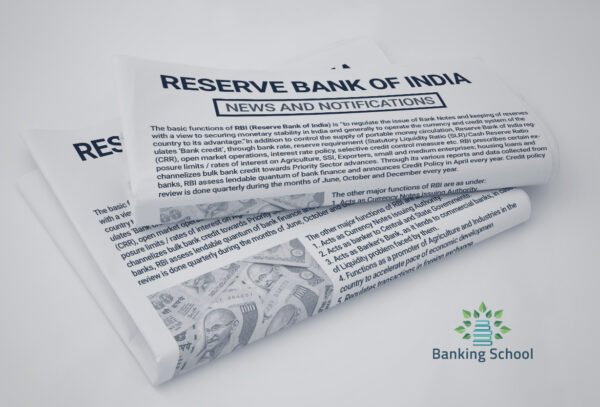
The Reserve Bank of India (RBI) is a statutory central bank established under the Reserve Bank of India Act, 1934, entrusted with monetary authority, financial stability, currency issuance, and oversight of payment and credit systems in India within a public-law governance framework anchored in statute and subordinate regulation. Over time, major organizational and functional developments—from…

Central Banking in Contemporary India: Autonomy, Credibility, and Fiscal-Monetary challenges

Central banking remains desirable in India because it anchors price stability, safeguards financial stability, and mitigates crisis dynamics through lender-of-last-resort functions while shaping expectations in a structurally supply-sensitive economy. India’s post-2016 flexible inflation targeting (FIT) regime, CPI anchoring, and a statutory Monetary Policy Committee (MPC) have institutionalized a rule-based, credible framework, improving macro predictability and…

Functions of a Central Bank: An Institutional Pillar of Monetary and Financial Stability

Central banks are among the most significant institutions in the architecture of modern economies. Their functions extend far beyond the traditional role of currency issuance, encompassing critical responsibilities in monetary policy, financial stability, economic development, and systemic regulation. By acting as banker to the government, banker to commercial banks, custodian of currency, and regulator of…